

S690 high-strength welded structural steel sections, featuring a yield ratio of < 0.9 and elongation of > 17%, are playing an increasingly important role in the construction of modern large-scale, high-density data centers (DCs).
Data centers are considered specialized industrial facilities characterized by high asset value, heavy operational loads, strict vibration-control requirements, and a strong emphasis on maximizing usable space. Due to the limitations of conventional hot-rolled manufacturing processes, structural sections with strengths exceeding 500 MPa are typically fabricated from high-strength steel plates through laser welding or automated welding processes that comply with stringent ISO 3834 and EN 1090-2 (EXC3/EXC4) quality requirements. These high-performance structural sections offer significant advantages in several key data center applications.
One of the most important applications is the primary beam system for large-span, heavily loaded server halls. To maximize flexibility in server rack layouts, data centers commonly adopt column-free or large-span structural arrangements, often requiring column grids of 9 m × 9 m, 12 m × 12 m, or larger. At the same time, each floor must support substantial equipment loads, including high-density AI servers, UPS battery systems, and associated infrastructure, with imposed loads frequently reaching 15–25 kN/m². By utilizing fabricated S690 H-sections as primary beams, designers can support these heavy loads without increasing beam depth or reducing valuable clear room height.
Another major application is rooftop support platforms for heavy mechanical and electrical equipment. Data center roofs are typically occupied by large chillers, cooling towers, diesel generators, and other essential infrastructure. These systems not only impose significant dead loads but also generate continuous mechanical vibrations while being exposed to outdoor environmental conditions. S690 laser-welded channels, angles, and square hollow sections can be used to construct multi-level steel support platforms. The high strength of S690 allows substantial reductions in steel self-weight, thereby reducing the secondary loads imposed on the building’s primary structure.
S690 structural sections are also highly suitable for modular and containerized data center construction. Prefabricated modular data centers are often fully assembled in manufacturing facilities before being transported by sea or land and lifted into position on site. During transportation and lifting, the structural frame must withstand concentrated lifting forces as well as dynamic transport-induced vibrations. High-strength S690QLH square and rectangular hollow sections manufactured in accordance with EN 10210-3 can be used as the primary load-bearing framework of modular pods. This solution significantly reduces overall lifting weight while maintaining excellent structural safety. The elongation of more than 17% also provides outstanding toughness during transportation and installation.
In seismic regions, S690 steel pipes and rectangular hollow sections can be utilized for seismic bracing systems. Data centers are regarded as critical infrastructure facilities, meaning that structural failure is unacceptable even during major seismic events. In addition to protecting the building itself, the structure must safeguard valuable semiconductor equipment, servers, and fiber-optic networks from excessive displacement. By taking advantage of the high ductility associated with a yield ratio below 0.9, S690 steel pipes and rectangular hollow sections can be incorporated into Buckling Restrained Braces (BRBs) and other seismic bracing systems. During an earthquake, these members can absorb substantial amounts of seismic energy through controlled plastic deformation, thereby enhancing overall structural stability and resilience.
The adoption of S690 welded structural sections in place of conventional S355 steel can generate a range of significant technical and economic benefits for data center projects. With a yield strength nearly twice that of S355, S690 allows structural members to be designed with substantially smaller cross-sections and reduced beam depths, often achieving reductions of approximately 30%–40%. These reductions create a series of downstream advantages, including increased usable space, lower building self-weight, and reduced overall steel consumption.
One of the most valuable benefits is the release of additional clear height within server halls. Data centers require extensive overhead space for cable trays, electrical distribution systems, hot- and cold-aisle containment ducts, AHU/CRAH piping, and fire-suppression systems. Using conventional S355 steel, beam depths may reach approximately 1.2 meters. By switching to S690, beam depths can potentially be optimized to around 0.8 meters, creating an additional 300–400 mm of clear space on each floor. Under the same overall building height limitation, this additional clearance may even make it possible to accommodate an extra data hall level.
S690 also contributes to improved vibration control. Sensitive equipment such as hard disk drives, optical communication systems, and precision electronic components can be adversely affected by structural vibrations. Due to their optimized cross-sectional efficiency and precise fabrication, S690 welded structural sections can provide higher structural stiffness and increased natural frequencies, helping the structure avoid resonance with large mechanical equipment such as diesel generators and cooling systems.
Furthermore, S690 can support the sustainability objectives of modern Green Data Centers. Although the material cost of S690 steel plates and advanced welding processes may be higher than conventional structural steel, the increased strength often allows total steel tonnage to be reduced by approximately 25%–35%. This reduction can offset part of the higher material cost while significantly lowering the project’s embodied carbon footprint. As a result, S690 structural solutions can assist data center developments in achieving green building certifications such as LEED and BEAM Plus while supporting long-term environmental performance objectives.
If you are planning a data center project and intend to incorporate BIM, MiC/DfMA, and prefabricated S690 high-strength welded structural steel sections, including H-beams, square hollow sections, rectangular hollow sections, I-beams, channels, angles, and steel pipes, you are welcome to contact our technical team. We can provide Material Test Certificates (MTC), factory certification documentation, and customized BIM/DfMA quotation solutions tailored to your project requirements.
- Previous:Who Are the Suppliers of S690 High-Performance Structural Steel Sections?
- Next:Already the latest article
-
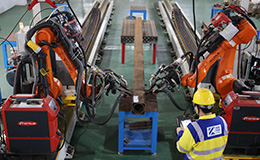 2026-9-03 EN 1090-2 Fabrication Technology and Specifications for Steel Structures
 -
 2024-12-06 Peak Kong Special Steel Showcases Advanced High-Strength Steel Structural Profiles at WCFS International Conference
 -
2026-9-08 Why Does S960 Steel Structural Section Choose Low-Temperature Tempering?
-
 2025-1-06 The welding team at Peak Kong Special Steel has successfully completed the welding procedure qualification for duplex stainless steel and super duplex stainless steel 2205/2507.
 -
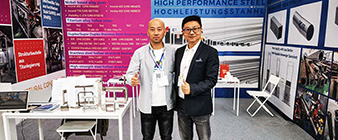 2026-5-28 Peak Kong Special Steel participated in the International Tubular Products Exhibition in Düsseldorf, Germany.
 -
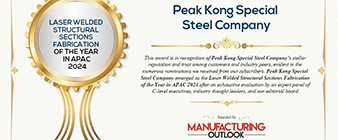 2025-1-11 Peak Kong Special Steel Wins APAC-2024 Laser Welding Structural Profile Manufacturer of the Year Award
 -
2026-9-10 Suppliers of S960 Ultra-High-Strength Steel Structural Sections