

Welding S960 ultra-high-strength steel on construction sites is the highest-risk and most difficult stage of the entire structural engineering process.
Unlike the controlled indoor environment of factory workshops, construction sites face severe challenges: wind speed, humidity, dramatic ambient temperature fluctuations, restricted welding positions (e.g. all-position welding, overhead welding at height), and extreme member constraint stresses. If site control is inadequate, fatal hydrogen-induced delayed cracking or severe HAZ softening/embrittlement can easily occur.
To successfully weld S960 on site, the following must be strictly enforced:
The construction site’s greatest enemies are water, wind, and moisture — the primary sources of “hydrogen.”
Establish windproof, rainproof, moistureproof enclosures: A sturdy enclosed welding shelter must be erected at the welding point. When wind speed exceeds 2 m/s or relative humidity exceeds 80%, work is absolutely prohibited without a complete shelter.
Welding consumable on-site extreme management: Mobile electrode/wire drying and holding ovens (maintained at 100 °C–150 °C) must be equipped on site. Welders may only draw 2–4 hours’ worth of consumables at a time, taken as used, and consumables must not be directly exposed to the humid site air, ensuring deposited metal diffusible hydrogen content at ultra-low-hydrogen levels.
Site components are typically large in volume, highly constrained, and cool extremely rapidly.
Precision preheating (T₀ = 100 °C – 150 °C): Visual estimation using ordinary gas torches is strictly prohibited! The site must use electric heating blankets (ceramic heating belts) for uniform preheating, or full-time personnel with far-infrared thermometers for continuous monitoring. The preheat range should cover at least 3× plate thickness and no less than 100 mm on each side of the weld.
Interpass temperature 180 °C:
During multi-pass, multi-run welding, after each pass is completed, the weld temperature must drop below 180 °C (and not below the preheat temperature) before the next pass can be welded.
Common site error: For productivity, welding the next pass while the previous one is still red-hot leads to excessive heat accumulation, directly destroying the S960 quenched-and-tempered microstructure and dropping HAZ strength by 20%–30%.
The skill and discipline of site welders is the decisive factor.
Strict heat input limit (0.5 – 1.5 kJ/mm): Site welding must use narrow-bead, multi-pass, multi-run welding, with the welding gun strictly prohibited from lateral oscillation (no weaving).
Welding sequence optimisation: For large on-site assemblies, symmetrical welding, segmented back-step welding, or a centre-outward sequence should be used to maximise release of the enormous structural lock-in stresses on site.
On-site “post-heat” iron rule: The instant welding is completed (while still hot), electric heating belts must immediately heat the weld zone to 200 °C – 250 °C, wrapped in insulation blanket, and held for 2 – 4 hours. This forces the trace hydrogen atoms that infiltrated the weld on site to accelerate out, nipping delayed cracking in the bud.
On-site portable hardness tester spot-check: Use a portable Leeb hardness tester to spot-check the weld and HAZ. Standard: HAZ maximum hardness must not exceed 450 HV (prevent hardening-induced brittle fracture); minimum hardness drop must not exceed 15% of base metal (prevent excessive softening).
Site NDT delayed iron rule:
UT or MT inspection on the same day as welding is absolutely prohibited! Because site hydrogen-induced cracking is often delayed, final NDT acceptance may only proceed at least 48 hours (preferably 72 hours) after welding and post-heat completion, otherwise latent delayed cold cracks can be easily missed.
• WPS (site welding procedure qualification): Has a “site-environment-simulated” procedure qualification been performed?
• Welder qualification: Have site welders passed the 960-grade high-strength steel all-position (e.g. 3G/4G/6G) specialised certification?
• Temperature records: Are point thermometers and temperature crayons equipped, with each weld having dedicated personnel signing off preheat and interpass temperature records?
-
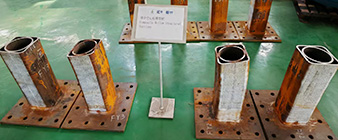 2025-1-06 Peak Kong Special Steel and Professor Liu Yaopeng’s team from South China University of Technology jointly tested and studied composite hollow structural profiles.
 -
 2024-12-06 Peak Kong Special Steel Showcases Advanced High-Strength Steel Structural Profiles at WCFS International Conference
 -
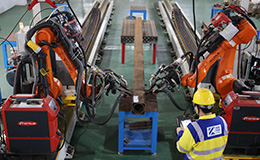 2026-9-10 Suppliers of S960 Ultra-High-Strength Steel Structural Sections
 -
 2024-8-01 Welcome to the High-Strength Steel Processing Delegation Visiting Our Company
 -
 2026-10-06 See you in Stainless Steel World Asia 2026(14–15 October)
 -
 2023-7-25 What is Corten steel?
 -
2026-9-05 Method Statement for Complete Fabrication and Installation of S960 Ultra-High Strength Steel Structures