

High-strength steel structure refers to a load-bearing system fabricated from high-performance structural steel with yield strength ≥ 460 MPa (such as S690 and S960 specified in premium European standard EN 10025-6). It is a core technology for cutting-edge modern engineering to break the limits of span and height.
• Bridge engineering: Steel box girders of long-span cross-sea bridges, suspension bridge towers, cable clamps and key load-bearing anchorage joints.
• High-rise and super high-rise buildings: Low-temperature massive composite columns, heavy-load transfer trusses and steel reinforced core shear walls for skyscrapers over 300 meters.
• Infrastructure: Extra-large span spatial pipe truss roofs for large high-speed railway stations, airport terminals and large stadiums.
• Special high-rise structures: Ultra-high communication towers, high-power wind turbine towers, heavy reaction kettle supports for chemical plants.
• Heavy port machinery: Large container gantry cranes, telescopic booms of ship unloaders, large mobile machinery structures for stock yards.
Performance advantages It features thinner cross-sections, lighter overall self-weight and higher load-bearing capacity while maintaining ultra-high yield strength.
High strength-to-weight ratio Its load capacity is 2 to 2.7 times that of conventional steel, which enables significant thickness reduction of components and optimal spatial cross-sections.
Construction efficiency Reduced plate thickness leads to geometric decrease of welding groove area, greatly lowering consumption of welding wire and welding man-hours. Lower self-weight largely cuts logistics transportation trips; smaller tonnage cranes can be adopted for on-site installation, resulting in remarkable reduction of indirect costs.
Sustainability Steel consumption can be reduced by up to 30%–50%, which greatly lowers carbon footprint from upstream steel smelting and downstream transportation and construction.
Structural Steel Sections
High-strength steel (S690/S960) is mainly manufactured into the following sections by high-precision laser fusion welding or heavy-duty cold bending process:
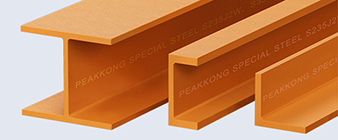
• H-Beams (HEA / HEB / IPE)
• I-Beams (UB / S / HEM)
• Channels (U & C-Shapes)
• Angles (equal and unequal leg L-Shapes)
• SHS (Square Hollow Sections)
• RHS (Rectangular Hollow Sections)
• CHS (Circular Hollow Sections)
Connection Methods
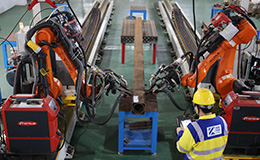
• Welding: All welding works are carried out in a controlled factory environment based on DfMA / MiC prefabrication.
• Bolted connection: Friction-type connections with Grade 10.9 or higher strength bolts are adopted for 100% of on-site splicing as the first choice.
Standards & Codes
• EN 1090-2 Technical requirements for steel structures: European Union and UK specification for fabrication and installation of steel structures.
• AISC (American Institute of Steel Construction): Standards of American Institute of Steel Construction.
• ASME (American Society of Mechanical Engineers): Standards of American Society of Mechanical Engineers.
Adopt BIM for 3D digital twin modeling, combined with one-stop factory prefabrication of Peakkong Special Steel, DfMA (Design for Manufacture and Assembly) and MiC (Modular Integrated Construction). 90% of welding, heat treatment and anti-corrosion processes (Sa2.5 shot blasting to replace pickling, galvanizing and painting) are completed inside the factory. After three-dimensional modules or large segments are delivered to site, rapid bolt assembly is implemented. New materials and technologies help reduce construction cost, achieve faster and higher-efficiency construction for the future.
-
 2026-9-03 Introduction to S690 & S960 High-Strength Steel Structures
 -
2026-9-07 Applications of S960 Ultra-High-Strength Steel in Buildings
-
2026-9-05 S960 Ultra-High Strength Steel Welding
-
 2023-7-25 What is Corten steel?
 -
2026-9-05 How to Repair Weld Defects in S690 High-Strength Steel Structures Already in Service?
-
2026-9-17 How to Lower the Yield-to-Tensile Ratio and Improve Elongation of S690 High-Strength Steel Structural Sections?
-
2026-9-17 Applications of S690 Structural Steel Sections in Data Centers