

In the field of high-performance advanced high-strength steel structures, precisely locking the Y/T of S690-grade structural steel sections within 0.9 while simultaneously pushing uniform elongation above 17% is the best standard for ensuring excellent seismic plastic energy-dissipation space in modern high-rise buildings, long-span bridges, and deep excavation support works.
To perfectly achieve and maintain this ultimate mechanical performance, a three-dimensional integrated core process closed loop of “strictly selected high-performance base metal + metallurgical-grade automated laser welding + precision-temperature-controlled low-temperature tempering” must be employed.
The following details how to precisely control Y/T and elongation across the full process:
Step 1: Source control — strictly selecting “low Y/T (≤0.9), high elongation (≥17%)” quenched-and-tempered base metal plates:Conventional high-strength steel plates, in single-minded pursuit of 690 MPa ultra-high yield strength, often sacrifice plasticity, resulting in delivery Y/T consistently above 0.93 and elongation below 14%. Microstructural tuning: Peak Kong Special Steel strictly selects at source high-performance steel plates processed via advanced TMCP (Thermomechanical Controlled Rolling) combined with offline precision quench-and-temper (Q+T) or Q&P (Quenching & Partitioning) processes. Microscopic mechanism: Such base metal, within the martensite/bainite matrix, precisely retains 5%–15% thin-film metastable retained austenite. When the section is loaded past the yield point, intense TRIP effect and dynamic dislocation tangling are triggered, activating an extremely high strain-hardening rate (n-value) during deformation, thereby lowering Y/T below 0.9 and pushing elongation to 17%–20% or above at the source.
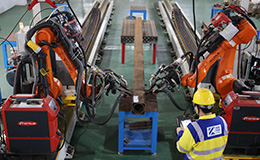
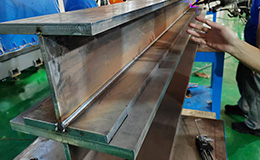
Step 2: Forming control — adopting automated “laser welding (Laser Fused)” process: Conventional arc welding (e.g. SAW submerged arc welding) has extremely high heat input, causing severe grain coarsening and excessive martensite decomposition in the weld and HAZ, collapsing the base metal’s excellent retained austenite, leading to HAZ embrittlement or massive softening, with Y/T approaching 1.0 (fracture beside the weld upon tension). Laser revolution: Peak Kong Special Steel adopts top-tier automated laser welding to prefabricate open and hollow sections (H-beams, UC/UB, square tubes, steel pipes). Ultra-low heat input: Laser welding energy is highly concentrated with an extremely high depth-to-width ratio. Its ultra-low heat input compresses the HAZ to the micron level, perfectly “sealing” the base metal’s original low Y/T and high elongation microstructure through extremely fast in-out thermal cycling, avoiding the microstructural degradation of conventional welding.
Step 3: Stress locking — post-weld precision “low-temperature tempering (150 °C – 250 °C)”:Although laser welding has extremely low heat input, the local ultra-rapid melting and solidification still leaves very high local structural stress around the weld, with potentially elevated micro-hardness. Precision quench-and-temper: Formed sections must enter a temperature-controlled heat treatment furnace for 150 °C–250 °C precision low-temperature tempering. Physical benefit: While not damaging the 690 MPa yield strength base, this process causes unstable phases to release early and carbon atoms to microscopically rearrange, eliminating over 80% of quenching and welding residual stress. This not only stabilises the section’s long-term service geometric dimensions but also optimises the overall micro-toughness of the weld, ensuring uniform Y/T and elongation across the entire section (base metal, weld, HAZ), blocking brittle self-cracking.
Sections have excellent properties ex-factory, but secondary processing and welding on site must strictly follow EN 1011 to preserve these structural properties:
Workshop/site medium-high-temperature secondary heating strictly prohibited:After welding deformation, flame torches for high-temperature hot straightening are absolutely prohibited, and conventional 600 °C stress-relief annealing (PWHT) is absolutely forbidden. This would completely destroy the fine-grained microstructure stabilised by the mill’s low-temperature tempering, dropping yield strength by 20%–30%.
Hardness indicator control:During post-weld HOKLAS-accredited micro-hardness testing, the weld and HAZ maximum hardness must be ≤ 450 HV (prevent hydrogen-induced delayed cracking), with no catastrophic softening (not below 210 HB), ensuring joint tensile strength 100% meets standard.
Correct low-temperature dehydrogenation:For on-site splicing welds, 200 °C–250 °C low-temperature post-heat (dehydrogenation) with 2–4 hours’ holding should be performed immediately after welding, forcing diffusible hydrogen to escape rapidly, reducing cold cracking risk to zero without damaging strength.
-
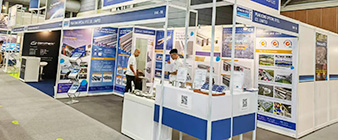 2024-12-06 Peak Kong Special Steel participated in the 2024 Singapore Asia Stainless Steel Exhibition.
 -
 2026-9-07 How to Control On-Site Welding of S960 Ultra-High-Strength Steel?
 -
2026-9-17 Who Are the Suppliers of S690 Steel Structural Sections?
-
2026-9-10 Suppliers of S960 Ultra-High-Strength Steel Structural Sections
-
 2026-6-16 S960QL Ultra-High Strength Structural Steel Profiles
 -
 2026-6-16 Composite Hollow Structural Profiles – The Future of Structures
 -
 2024-12-06 Peak Kong Special Steel Showcases Advanced High-Strength Steel Structural Profiles at WCFS International Conference