

S960 ultra-high-strength steel structural sections (e.g. S960QL / S960QL1) “must” undergo precision-controlled low-temperature tempering (typically 150 °C – 250 °C) at the steel mill before delivery. This is not only the quench-and-temper core that gives S960 its 960 MPa ultimate load-bearing capacity, but also the engineering cornerstone for meeting the quality control requirements of the European welding standard EN 1011.
The following breaks down the four core reasons for choosing and controlling the low-temperature heat treatment process, based on the engineering and metallurgical logic of EN 1011 (Recommendations for welding of metallic materials):
EN 1011 principle: EN 1011-2 Annex C provides detailed cooling time (t8/5) and hardness control logic for preventing hydrogen cracking. The pure martensitic matrix of high-strength steel after quenching has severely distorted crystal lattice, extremely high hardness, and enormous internal stress.
Low-temperature tempering solution: Through 150 °C – 250 °C low-temperature tempering, the steel mill, while maximally retaining 960 MPa yield strength (preventing softening failure from high-temperature tempering), promotes micro-rearrangement of internal carbon atoms, releasing up to 80% of quenching stress. This controls the section hardness below the critical safety line recommended by EN 1011, completely cutting off the brittle self-cracking caused by high internal stress.
EN 1011-2 explicitly states that the greatest enemy of high-strength steel welding is hydrogen-induced cracking (HIC). The standard requires comprehensive assessment of:
1. Material carbon equivalent (CEV)
2. Combined component wall thickness
3. Welding heat input
4. Deposited metal diffusible hydrogen content (Hd)
Low-temperature dehydrogenation requirement: S960 has a high yield-to-tensile ratio (>0.90) and is extremely sensitive to hydrogen. Per EN 1011 guidance, immediately upon completion of welding (shop or site), a 200 °C – 250 °C low-temperature post-heat (dehydrogenation treatment) with 2–4 hours’ holding must be performed. This low-temperature heat treatment forces residual diffusible hydrogen atoms out of the weld and is the baseline for passing EN 1011 welding procedure qualification (WPQR).
This is the most important standard warning for construction units.
EN 1011-1 warning (Clauses 5.1.3/5.1.4): For quenched-and-tempered steel (QT, e.g. S960QL) or thermomechanically processed steel (TMCP, e.g. S960M), their excellent mechanical properties and low yield-to-tensile ratio are highly dependent on the steel mill’s precision low-temperature / controlled-cooling heat treatment.
Conventional PWHT prohibited: EN 1011 explicitly states that such ultra-high-strength steels must not undergo conventional medium-high-temperature (e.g. 550 °C – 650 °C) post-weld stress-relief annealing (secondary tempering) after welding. Once site temperature exceeds 550 °C, the fine-grained martensitic matrix originally stabilised by low-temperature tempering undergoes intense recovery and recrystallisation, causing severe grain coarsening in the HAZ, producing a serious “softening zone,” and dropping section strength directly by 20%–30% — the structure is declared scrapped.
Hardness uniformity: Per EN 1011, hardness traverse testing (Vickers Hardness Test) of welded joints must be performed during procedure qualification.
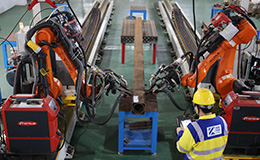
Physical benefit of low-temperature process: The steel mill’s low-temperature tempering retains high-density dislocations and metastable microstructures (e.g. retained austenite, triggering the TRIP effect). This gives the material a good strain-hardening rate (n-value) when loaded, effectively raising tensile strength and lowering the yield-to-tensile ratio (to 0.85–0.88). This microstructure ensures that during robotic narrow-bead welding, the HAZ hardness variation curve is very smooth, with maximum hardness not exceeding the 450 HV required by the standard, avoiding sudden brittle fracture from localised over-hardening.
If you need support in S960 ultra-high-strength steel structural sections (H-beams, channels, I-beams, large-diameter thick-walled tubes) selection, or EN 1011 welding procedure qualification (WPQR/WPS), we look forward to deep technical collaboration with your engineering project!
-
 2026-9-09 Low-Temperature Tempering Process for S690 High-Performance Structural Sections
 -
2026-9-05 Rework Procedure for S960 Ultra-High-Strength Steel Structural Welds
-
 2026-10-05 Peakkong Special Steel successfully completed its participation in the 12th Shanghai International Pipe Materials Exhibition.
 -
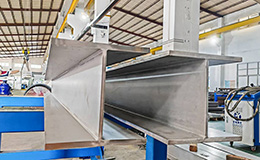 2026-6-16 Duplex/Super Duplex Stainless Steel Structural Profiles 2304/2205/2507
 -
2026-9-03 Introduction to High-Strength Steel Structures
-
2026-9-10 How to Improve the Yield-to-Tensile Ratio and Elongation of S960 Ultra-High-Strength Steel Structural Sections?
-
2026-9-03 Introduction to S690 & S960 High-Strength Steel Structures