

In highway bridge applications (including highway overpasses, viaducts, large pedestrian footbridges at major junctions, and extra-long-span bridges), the introduction of S960 ultra-high-strength steel (Yield Strength ≥ 960 MPa) represents a disruptive revolution in traditional civil infrastructure.
Long-span truss bridges and orthotropic steel decks (Long-Span Trusses & Orthotropic Decks): Highway bridges (especially overpasses spanning rivers and high-speed rail lines) require extremely large spans. S960 is commonly used for main load-bearing trusses, main chords, and compression diagonals. In orthotropic steel bridge decks of steel box girders, which bear direct wheel loads and high-frequency fatigue loading, S960 can significantly reduce the thickness of the top plate and U-ribs, substantially reducing the main girder self-weight.
Anchorage steel box girders and key tower nodes for cable-stayed and suspension bridges (Anchorage & Tower Nodes): Cable-stayed and suspension bridges rely heavily on stay cables to transfer loads to the main tower. The anchorage node zones of stay cables inside the steel box girder experience extreme stress concentration. Using S960 to manufacture heavy-duty anchorage boxes, compression struts, and steel cross-beams of the main tower can withstand thousands of tonnes of cable force with extremely lightweight sections, optimising the geometric space at the tower-box-girder connection.
Overpass decks and complex interchange elevated structures (Complex Interchange Decks): At busy highway interchanges, complex underground utilities and dense existing traffic do not permit dense pier construction at ground level. S960 streamlines steel box girder decks, reducing structural weight by nearly 90% compared to conventional concrete decks (e.g. 2,500 tonnes of concrete reduced to 280 tonnes of steel), enabling large bridge decks to be factory-modularised and rapidly lifted with few large steel columns and strand jacks without road closures.
“Structural slimming” with cascading reduction in foundation pile scale: S960’s strength is nearly three times that of conventional bridge structural steel (S355). The dead load of the bridge structure typically occupies a large portion of the design load. With higher steel strength, the bridge body becomes thinner and lighter, significantly reducing the number and scale of foundation piles and piers in complex underground environments, perfectly circumventing intricate utilities and geological defects.
Drastic reduction in construction period and social costs: Road closure construction (e.g. spanning existing highways or railways) carries extremely high social costs. The lightweighting brought by S960 enables full factory prefabrication, large-module transport, and minimal-equipment lifting. In the Hong Kong Fanling project, S960 successfully shortened on-site construction by one year and reduced overall construction costs by nearly 30%.
Significant reduction in full-life-cycle carbon emissions: Under the global push for green infrastructure and sustainable development, although ultra-high-strength steel smelting is demanding, the total steel tonnage is reduced by over 30%–40%, reducing the total carbon emissions from material production, transport, and lifting by up to 65%.
Since highway bridges directly bear high-frequency vehicle dynamic impact, fatigue, and harsh outdoor environments, the following defence lines must be strictly enforced when applying S960:
Fatigue life and stress concentration defence: Although S960’s static strength is three times that of S355, the fatigue strength of steel does not increase proportionally with static strength, especially at welded joints. Structural design must therefore include precision grinding of weld toes and roots, and may employ ultrasonic impact treatment (UIT) or laser shock peening to eliminate welding residual stress and geometric stress concentration.
Low heat input welding (precise heat control): Highway bridges demand extremely high seismic and low-temperature impact toughness. High-precision low-heat-input welding technology (typically limited to 0.5–1.5 kJ/mm) developed by the PolyU team must be adopted, paired with 100% NDT (UT/MT), to prevent HAZ grain coarsening and delayed cracking.
Stiffness and deformation control (deflection limits): The elastic modulus of steel (E ≈ 210 GPa) is constant and does not change with strength. With S960’s reduced cross-section, the overall structural stiffness decreases, making the bridge more susceptible to oscillation or local buckling. Therefore, longitudinal and transverse stiffeners must be increased, or steel-concrete composite structures must be used to ensure the bridge’s deflection meets code requirements.
Sa 2.5-grade corrosion protection and surface hydrogen-embrittlement-prevention coating: Highway bridges are perennially exposed to outdoor or high-salt environments (e.g. coastal bridges) and must undergo stringent abrasive blasting to at least Sa 2.5 grade. However, traditional strong-acid pickling is strictly prohibited, as the hydrogen atoms released during pickling will directly penetrate S960 ultra-high-strength steel, causing severe delayed surface hydrogen-embrittlement fracture.
S960 entering highway bridges proves that as long as the two keys of “precision welding heat control” and “stiffness/fatigue geometric design” are mastered, ultra-high-strength steel can perfectly overcome the limitations of a high yield-to-tensile ratio.
-
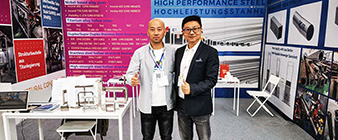 2026-5-28 Peak Kong Special Steel participated in the International Tubular Products Exhibition in Düsseldorf, Germany.
 -
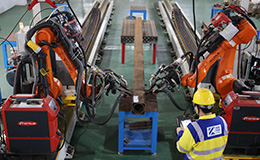 2026-9-03 High-strength Steel Structure
 -
 2026-6-16 Composite Hollow Structural Profiles – The Future of Structures
 -
2026-9-17 Advantages of Low-Temperature Tempering for S690 Structural Steel Sections
-
2026-9-17 Who Are the Suppliers of S690 Structural Steel Sections?
-
 2025-1-06 The welding team at Peak Kong Special Steel has successfully completed the welding procedure qualification for duplex stainless steel and super duplex stainless steel 2205/2507.
 -
2026-9-10 How to Improve the Yield-to-Tensile Ratio and Elongation of S960 Ultra-High-Strength Steel Structural Sections?