

For weld defect rework on S690 grade ultra-high strength steel (S690QL / S690QL1), air carbon arc gouging cannot be used directly as with conventional S355 steel.
Ultra-high strength steel subjected to secondary welding thermal cycles suffers severe secondary hardening, grain embrittlement and stress superposition in the HAZ, which may lead to catastrophic delayed cracking or hydrogen embrittlement fracture.
To ensure mechanical properties and low-temperature impact toughness of reworked areas fully comply with EN 1090-2 EXC3/EXC4 standards, Peakkong Special Steel’s dedicated technical control process for S690 weld rework is outlined below:
Defect location and assessment When delayed NDT reports (100% UT + 100% MT after 24–48 hours) identify unacceptable internal weld defects (cracks, lack of fusion, slag inclusion or oversized porosity), the length, depth and exact 3D position of defects shall be accurately measured and recorded.
Dedicated Rework WPS review A separate Rework Welding Procedure Specification (Rework WPS) must be prepared for any S690 weld rework. Maximum two reworks are permitted at the same location. If the second rework fails inspection, the component shall be cut and scrapped, or a technical review panel convened by the Responsible Welding Coordinator (RWC).
Defect location → Stop-hole drilling at both ends → Mechanical grinding and grooving (air gouging strictly prohibited) → 100% MT verification of complete defect removal → Install ceramic heating pads (preheat to 130–150°C) → Multi-pass repair welding (controlled heat input) → Immediate post-weld hydrogen removal at 250°C + slow cooling with insulation blankets → Stand for 48 hours → 100% UT & MT re-inspection and acceptance.
1. Stop-hole drilling (prevent crack propagation) For crack defects, stop holes with diameter Φ8–10mm shall be mechanically drilled at least 50mm beyond each end of the crack prior to removal, breaking the stress chain that would allow crack extension into the base metal during subsequent heating.
2. Mechanical grinding and grooving (air carbon arc gouging completely forbidden for S690 rework) Air carbon arc gouging is prohibited for S690 rework, as its high heat and carburizing effect create an extremely brittle hardened layer on high-strength steel surfaces. Correct method: Pure mechanical grinding using straight grinding heads or special tungsten carbide rotary cutters. Grooves shall form a smooth U-shape (groove angle ≥ 60°, root radius ≥ 6mm) to ensure full penetration during repair welding.
3. 100% MT inspection of grooved surfaces After confirming full defect removal, grooved surfaces are cooled to ambient temperature and subject to 100% Magnetic Particle Testing (MT). Only when all original unacceptable defects (especially cracks) are fully removed may work proceed to the next stage.
4. Elevated preheating temperature (130°C – 150°C) Constraint stress around rework grooves is far higher than for initial welding, so preheating temperature for rework shall be 20–30°C higher than standard welding preheating. Crawler-type ceramic heating pads are mandatory to uniformly heat the entire rework zone plus 4 times the plate thickness on both sides to 130–150°C. Local uneven heating with gas torches remains prohibited.
5. Strict heat input limits and short-pass repair welding Repair welding uses H5 ultra-low hydrogen flux-cored welding wire (FCAW), baked and kept warm prior to use. Welding heat input is strictly locked at 1.0 – 2.0 kJ/mm (lower than standard welding parameters). Multi-pass, slight oscillation and short weld pass techniques are adopted; wide single-pass oscillation is forbidden. Interpass temperature is tightly controlled between 125°C – 180°C. Heat from each small weld bead provides self-tempering to the underlying layer, repairing HAZ microstructure to the maximum extent.
1. Enhanced immediate post-weld hydrogen removal heat treatment After completion of repair welding and before the weld cools down, ceramic heating pads are heated to 250°C for hydrogen removal treatment. Insulation duration: 1.5 hours per 25mm of plate thickness (30 minutes longer than standard welding). The area is then fully wrapped with thick asbestos insulation for natural slow cooling to force residual diffusible hydrogen to escape and relieve rework-induced stress.
2. Precision transition grinding of reworked surfaces After slow cooling to ambient temperature, the repaired area is ground to form a smooth continuous transition with the original weld and base metal, free of undercut, craters or grinding marks.
3. 48-hour delayed 100% NDT re-inspection After weld cooling, components remain in the factory for a full 48 hours before NDT inspection is carried out. Re-inspection consists of 100% UT (or PAUT) plus 100% MT. Acceptance criteria strictly follow Class B (highest quality grade) requirements specified in EN 1090-2.
Each rework location shall be filed separately in the factory FPC quality system documentation. Records shall include:
• Original NDT defect report number and 3D defect location drawing;
• Dedicated Rework WPS number and approver’s signature;
• ISO 9606-1 certificate number of the welder performing rework (the welder must hold advanced rework qualification);
• Dedicated rework temperature control records (MT verification after mechanical grooving, 130–150°C preheating temperature, 250°C hydrogen removal duration);
• New qualified 100% UT/MT report number obtained after 48 hours of delayed re-inspection.
-
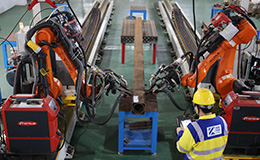 2026-9-17 Who Are the Suppliers of S690 High-Performance Structural Steel Sections?
 -
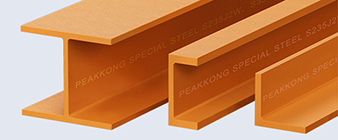 2023-7-25 What is Corten steel?
 -
2026-9-17 How to Lower the Yield-to-Tensile Ratio and Improve Elongation of S690 High-Strength Steel Structural Sections?
-
2026-9-05 S960 Ultra-High Strength Steel Welding
-
2026-9-03 Method Statement for Fabrication and Installation of S690QL Steel Structures
-
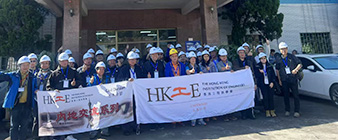 2024-12-06 A warm welcome to the Civil Division of the Hong Kong Institution of Engineers for visiting the Peak Kong Special Steel factory.
 -
2026-9-10 How to Improve the Yield-to-Tensile Ratio and Elongation of S960 Ultra-High-Strength Steel Structural Sections?