

In Hong Kong and international heavy foundation engineering, S690-grade high-performance structural steel (Yield Strength ≥ 690 MPa) piling H-beams (S690 Piling H-Beams / H-Piles), when directly replacing conventional S450 (e.g. S450J0) H-beams, possess overwhelming technical and economic advantages.
Whether in deep excavation lateral support (ELS), retaining steel pile walls, heavy-duty pile foundations, or underground temporary protection works, S690’s core advantages over S450 can be summarised across the following five dimensions:
Powerful “rock-penetration force,” easily driving into hard rock bearing layers (Hard Rock Penetration): S450 conventional pain point: Per CEDD geotechnical standards, heavy-duty steel piles must be driven to slightly decomposed granite (Grade I/II Rock) or similar hard bearing layers. S450 piles, under continuous heavy hammer (hydraulic or diesel) impact, easily suffer local buckling, wrinkling, or curling at the pile head and body due to insufficient compressive strength, resulting in “inability to reach design depth” or local pile damage and scrapping. S690 performance: Yield strength (≥ 690 MPa) is nearly 55% higher than S450 (≥ 450 MPa), giving the H-pile body extremely high longitudinal compressive stiffness and ultimate buckling resistance, transmitting 100% of the hammer impact wave to the pile tip, ensuring precise driving to design bedrock depth.
Ultra-high bending stiffness, perfectly controlling excavation lateral deformation (ELS Deflection Control): Lateral earth pressure defence: In deep excavation, retaining H-piles (King Posts) bear enormous lateral earth and water pressure. International geotechnical standards impose stringent limits on ground settlement around the excavation and lateral displacement of retaining structures. Material elastic limit improvement: S690 allows reducing steel cross-section area and wall thickness by 30%–40% while meeting the same bending moment capacity. Lighter S690 H-beams provide higher, safer elastic limits than heavier S450, effectively locking in lateral displacement and reducing settlement risk to adjacent buildings and underground utilities.
Excellent “low Y/T (~0.88)” and high elongation, safeguarding the extreme seismic baseline: Slip and plastic energy dissipation: High-performance structural steel piles underground must possess sufficient ductility to handle uneven ground settlement or lateral shear from seismic waves. Metallurgical control: High-end S690 piling H-beams undergo precision low-temperature tempering (150 °C–250 °C), stably controlling Y/T at around 0.85–0.88 with total elongation exceeding 17%.
Cross-section slimming and structural lightweighting, cascading reductions in logistics, lifting, and equipment costs: Equipment and logistics optimisation: Significantly reduced single-pile self-weight (over 30% reduction) allows smaller-tonnage cranes and piling rigs, extremely beneficial for urban sites with narrow spaces and complex underground utilities, dramatically optimising on-site equipment configuration and saving rental costs. Construction period reduction: In-factory high-precision robotic automated laser welding (Laser Fused) of H-beams with patented steel pipe pile interlocking connections as integrated modular prefabrication, enabling rapid splicing of ultra-long piles on site, significantly shortening foundation construction period.
Green low-carbon infrastructure dividend: significantly reduced full-life-cycle carbon emissions: With reduced total foundation steel weight, the carbon footprint across smelting, cross-border transport, and heavy machinery driving is correspondingly reduced, perfectly aligned with modern low-carbon green infrastructure initiatives.
If you are undertaking technical selection and pricing of S690 (replacing S450) piling H-beams for public or private infrastructure projects (e.g. reclamation retaining walls, site temporary ELS, heavy-duty foundation piles), and need more detailed third-party HOKLAS certification reports for compiling WPS and Method Statements compliant with EN 1011 / EN ISO 15614 for consultant or government submission, please contact the Peak Kong Special Steel technical team.
- Previous:Advantages of S690 Piling H-Beams
- Next:Already the latest article
-
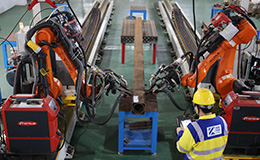 2026-9-05 S960 Ultra-High Strength Steel Welding
 -
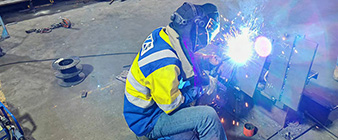 2024-12-31 Peak Kong Special Steel Welding Team Successfully Completes S960QL Ultra-High-Strength Steel PF and PC Welding Procedure Qualification
 -
2026-9-03 How to Achieve Faster Construction with High-Strength Steel Structures
-
2026-9-03 Method Statement for Fabrication and Installation of S690QL Steel Structures
-
2026-9-05 How to Repair Weld Defects in S690 High-Strength Steel Structures Already in Service?
-
2026-9-05 Rework Procedure for S960 Ultra-High-Strength Steel Structural Welds
-
2026-9-08 Why Does S960 Steel Structural Section Choose Low-Temperature Tempering?