

Welding S690 high-strength steel structural sections (H-beams, piling H-beams, steel pipe truss structures) on construction sites is the most difficult and risk-critical stage of the entire heavy infrastructure and foundation engineering process.
Unlike the controlled indoor environment of factory workshops, construction sites face wind speed, humidity, and dramatic ambient temperature fluctuations, with extreme member constraint stresses. If control is inadequate, fatal hydrogen-induced delayed cracking or severe HAZ softening/embrittlement can easily occur after welding.
To ensure on-site welding quality 100% passes the supervising engineer and inspector’s acceptance, the following on-site control measures must be implemented per EN 1011:
On-site moisture, wind, and rain are the primary sources of “hydrogen,” and high-strength steel is extremely hydrogen-sensitive.
Erection of protective shelters:A sturdy enclosed windproof, rainproof, moistureproof shelter must be erected at the welding point. When wind speed exceeds 2 m/s or relative humidity exceeds 80%, work is absolutely prohibited without a complete shelter.
Welding consumable drying and on-site storage:Mobile electrode/wire drying and holding ovens (maintained at 100 °C–150 °C) must be equipped. Welders may only draw 2–4 hours’ worth of consumables at a time, with consumables never directly exposed to site air, ensuring deposited metal diffusible hydrogen content (Hd ≤ 5 ml/100 g).
Site piling sections or mega-column walls are typically thick, highly constrained, and dissipate heat extremely rapidly, requiring strict temperature control.
Precision preheating (T₀ = 75 °C – 120 °C):Per EN 1011-2 Annex C, uniform preheating must be performed before welding. Visual estimation with ordinary gas torches is strictly prohibited! Electric heating blankets (ceramic heating belts) must be used, with far-infrared thermometers for continuous monitoring. Preheat range: at least 3× plate thickness and no less than 100 mm on each side of the weld.
Locked interpass temperature (T_i ≤ 180 °C):During multi-pass welding, after each pass, the weld temperature must drop below 180 °C (and not below preheat temperature) before the next pass. Common site error: for productivity, welding the next pass while the previous is still red-hot, causing excessive heat accumulation that destroys the S690 microstructure locked by low-temperature tempering, leading to severe HAZ softening and strength collapse.
Site welder discipline is the key to preserving joint Y/T and elongation.
Heat input limit (1.0 – 2.5 kJ/mm):Narrow-bead, multi-pass welding must be used, with the welding gun strictly prohibited from large lateral oscillation (no weaving). Site supervisors must periodically audit and calculate heat input.
Undermatching strategy:For non-primary-load fillet welds or highly constrained complex nodes on site, undermatching (e.g. selecting 600 MPa-grade consumables) is recommended. The better plasticity of the weld metal deforms to actively release the enormous structural lock-in stress.
This is the ultimate defence against site “delayed cracking.”
Post-heat dehydrogenation: The instant welding is completed (while hot), electric heating belts must immediately heat the weld zone to 200 °C–250 °C, wrapped in insulation blanket, held for 2–4 hours. This forces trace hydrogen atoms that infiltrated the weld to accelerate out.
High-temperature secondary tempering and flame straightening strictly prohibited:After member deformation, high-temperature flame straightening is absolutely prohibited, and conventional 600 °C stress-relief annealing is absolutely forbidden! This would destroy the mill’s quenched-and-tempered microstructure, causing strength to collapse.
Portable hardness tester spot-check: Use a portable Leeb hardness tester to spot-check the weld and HAZ. Standard: HAZ maximum hardness ≤ 450 HV (prevent hardening-induced brittle fracture); minimum hardness drop ≤ 15% of base metal (prevent excessive softening).
Site NDT delay:Since hydrogen-induced cracking has a “delayed occurrence” characteristic, UT or MT inspection on the same day as welding is absolutely prohibited! Final NDT acceptance may only proceed at least 48 hours (recommended 72 hours) after welding and post-heat completion, otherwise latent delayed cold cracks can be easily missed.
On-site welding is a perfect synergy of “material ultra-high-strength” and “precision on-site temperature control.” Please contact the Peak Kong Special Steel technical team. We provide a full set of on-site welding control technical parameters compliant with EN 1011, ensuring your site construction is safe, efficient, and compliant!
-
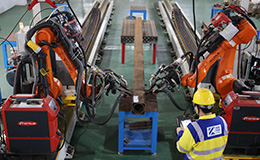 2026-9-17 Applications of S690 Structural Steel Sections in Data Centers
 -
 2026-5-28 Peak Kong Special Steel participated in the International Tubular Products Exhibition in Düsseldorf, Germany.
 -
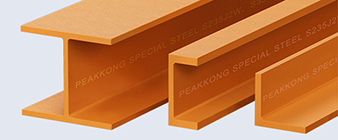 2023-7-25 What is Corten steel?
 -
2026-9-03 High-strength Steel Structure
-
2026-9-03 EN 1090-2 Fabrication Technology and Specifications for Steel Structures
-
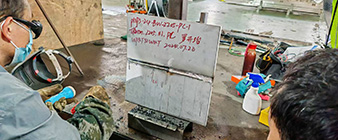 2025-1-06 The welding team at Peak Kong Special Steel has successfully completed the welding procedure qualification for duplex stainless steel and super duplex stainless steel 2205/2507.
 -
2026-9-05 S690 High-Strength Steel Welding