

In modern construction engineering, the application of S960-grade ultra-high-strength steel (Yield Strength ≥ 960 MPa) represents the pinnacle of structural steel technology. Although it presents challenges such as a high yield-to-tensile ratio and welding sensitivity, its strength is nearly three times that of conventional structural steel (e.g. S355).
To ensure the repaired weld fully restores the original design load-bearing capacity and complies with EN 1090-2 EXC3/EXC4 operational maintenance specifications, the following dedicated on-site repair procedure — “live-load dynamic monitoring, flame-free/low-heat repair, dual delayed verification” — must be executed:
Main trusses for ultra-long-span spatial structures (Long-Span Trusses): Application: Roof main cantilever beams and large-span tubular trusses for large stadiums, high-speed rail stations, and international airport terminals. Function: In spatial structures with spans exceeding 100 or even 200 metres, the structure’s self-weight often consumes most of the load-bearing capacity. Using S960 steel for the main chord members of trusses can significantly reduce member cross-sections and wall thicknesses, achieving extreme spans and a lightweight visual effect that conventional steel cannot accomplish, without sacrificing safety.
Mega-columns and core-wall nodes at the base of super-tall buildings (Super-Tall Building Columns): Application: Mega steel-reinforced concrete columns at the base of 600 m+ super-tall buildings, and mega-truss nodes at the force-transfer level between the core wall and the perimeter frame. Function: Columns at the base of super-tall buildings bear devastating axial gravity loads. With conventional steel, the column cross-section would be so large as to consume excessive commercial floor area. S960 can significantly reduce column geometry, increase the building’s net usable area (lowering the core ratio), and reduce the total load on the foundation.
Heavy-duty welded connection nodes and cast-steel replacement (Heavy-Duty Connection Nodes): Application: Complex tree-branch support nodes where multiple structural members converge, and end anchorages for cable-stayed structures. Function: At geometrically complex intersections with extreme stress concentration, S960 steel plates can be assembled via precision welding (e.g. laser cladding) into non-standard heavy-duty nodes, replacing bulky cast-steel components, reducing structural self-weight, and improving connection reliability.
High-end curtain wall support structures and landscape skybridges (Architectural Exposed Steelwork — AESS): Application: Ultra-tall, ultra-wide glass curtain wall cable-net support structures, and skybridges connecting buildings at height. Function: These structures demand extremely high visual transparency. S960 allows designers to use extremely slender steel columns, square tubes, or tie rods to resist enormous wind loads and cantilever tensile forces, achieving the “slender, minimalist, high-transparency” aesthetic of modern architecture.
Disruptive weight reduction (high strength-to-weight ratio): Under equivalent design loads, using S960 to replace S355 steel can reduce structural steel consumption by up to 40% – 50%. This not only directly saves material procurement costs but also significantly reduces foundation construction costs, transportation costs, and lifting difficulty.
Significant carbon emission reduction (green building indicator): Although S960 production is technically complex, the near-halving of steel usage significantly reduces the embodied carbon of the steel structure over its full life cycle. This is a major advantage in top-tier projects pursuing LEED or green building certification.
Excellent high-strain-rate (dynamic defence) performance: Academic research (e.g. by the Hong Kong Polytechnic University team) confirms that although S960 has a high yield-to-tensile ratio, its sensitivity to high-strain-rate loads (earthquakes, wind vibration, blast) is extremely low. Under sudden extreme impact, its yield strength does not cause overall instability through sudden strength spikes as low-carbon steel would, demonstrating good dynamic structural safety.
In building codes, a high yield-to-tensile ratio (>0.90) means the material lacks ductility after yielding — a fatal flaw in seismic design. To safely use S960 in buildings, structural engineers typically adopt the following solutions:
Concrete-Filled Steel Tubular structures (CFST/CFT): S960 is formed into square or circular tube columns, and ultra-high-strength concrete is poured inside. The outer S960 tube provides powerful confinement for the concrete, while the concrete completely suppresses local buckling of the high-strength tube. The combination produces excellent ductility and energy dissipation, perfectly masking the high yield-to-tensile ratio drawback of S960 as a standalone material.
Reduced Beam Section nodes (Dog-bone nodes, RBS): The beam end is locally geometrically weakened (deliberately cut away). Since S960 material itself has limited plastic deformation capacity, the geometric configuration forces the plastic hinge to occur in the specific weakened zone during an earthquake, protecting the beam-column core weld from brittle fracture and satisfying the seismic baseline of “strong column, weak beam, strong joint.”
The application of S960 ultra-high-strength steel in buildings is a perfect synergy between “material high-strength” and “geometric structural design.” It is no longer simple steel-plate welding but must be used in conjunction with CFST composite structures and RBS energy-dissipation nodes.
-
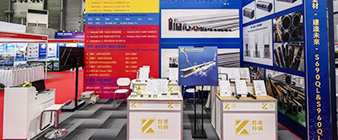 2026-10-05 Peakkong Special Steel successfully completed its participation in the 12th Shanghai International Pipe Materials Exhibition.
 -
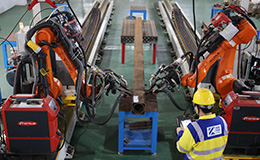 2026-9-05 S960 Ultra-High Strength Steel Welding
 -
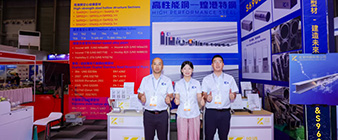 2026-10-06 See you in Stainless Steel World Asia 2026(14–15 October)
 -
2026-9-10 How to Improve the Yield-to-Tensile Ratio and Elongation of S960 Ultra-High-Strength Steel Structural Sections?
-
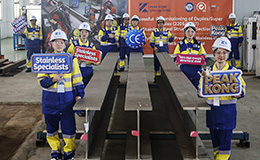 2026-6-16 Stainless Steel Structural Profiles 316L/1.4404
 -
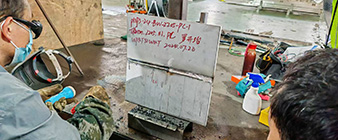 2025-1-06 The welding team at Peak Kong Special Steel has successfully completed the welding procedure qualification for duplex stainless steel and super duplex stainless steel 2205/2507.
 -
2026-9-17 Applications of S690 Structural Steel Sections in Data Centers