

EN 1090-2 (BS EN 1090-2) is the core and most authoritative technical specification for fabrication and installation of steel structures in the European Union and the United Kingdom. It is a mandatory access threshold for factories participating in international projects adopting European standards, including projects of Highways Department, Architectural Services Department and MTR in Hong Kong.
For factories like Peakkong Special Steel undertaking ultra-high strength steel structures such as S690 and S960, in-depth interpretation and compliant implementation of EN 1090-2 constitute the legal basis for engineering quality.
The core technical framework and mandatory inspection indicators of EN 1090-2 are fully analyzed below:
According to Consequence Class, Hazard Category and Production Category, EN 1090-2 divides steel structures into four Execution Classes (EXC1 to EXC4). Higher class means stricter technical review and quality control.
• EXC1: Low-risk structures (e.g., agricultural greenhouses, canopies, ordinary single-storey civil buildings).
• EXC2: General civil and industrial structures (e.g., multi-storey residences, conventional factories, commercial office buildings). It is the default benchmark class for international projects.
• EXC3: High-load, dynamic-load, seismic-resistant and large-span structures (e.g., high-speed railway stations, airport terminals, long-span cross-sea bridges, super high-rise skyscrapers, heavy portal frames, steel trusses).
• EXC4: Special extreme structures / national high-risk facilities (e.g., nuclear island steel structures, giant dam gates, high-risk public buildings).
Note for S690/S960 high-strength steel: As specified in the standard, when steel grade is higher than S460 (including S690 and S960) and applied in structures bearing dynamic load or high fatigue load, the project shall be compulsorily classified as EXC3 or EXC4.
For fabrication of S690/S960 high-strength steel under EXC3/EXC4, EN 1090-2 sets the following non-negotiable mandatory quality indicators:
100% Material Traceability (EXC3/EXC4 requirement) From raw material arrival, heat marks and heat numbers on steel plates must be accompanied by EN 10204 3.1 or 3.2 Material Test Certificates (MTC). After cutting and forming, heat number and welding serial number must be permanently marked on each component. No untraceable steel materials are allowed to enter the production line.
Welding Procedure Qualification and Welder Qualification (pWPS, WPQR, WPS)
• Preliminary Welding Procedure Specification (pWPS): Compiled by professional welding engineers in advance.
• Welding Procedure Qualification Record (WPQR, EN ISO 15614-1): Actual test plate welding shall be carried out under witness of a third-party institute, followed by tensile, bending, metallographic and hardness tests. Hardness limit: Maximum hardness of Heat Affected Zone (HAZ) of high-strength steel is strictly limited to ≤ 450 HV10 to avoid local embrittlement.
• Welder qualification (ISO 9606-1): All welders hold valid certificates, and the scope of qualification (welding method, plate thickness 8–50mm, welding position 3G/4G etc.) shall fully match actual construction conditions.
Strict Welding Temperature Control and Post-heat Hydrogen Removal (in accordance with EN 1011) Welding of high-strength steel must comply with EN 1011 temperature control standard referenced by EN 1090-2. Uniform preheating at 100–150°C by ceramic heating pads is required to reduce cooling rate and prevent formation of brittle martensite. Immediate post-weld hydrogen removal treatment at 200–250°C shall be conducted, followed by slow natural cooling wrapped with thick thermal insulation cotton to remove diffusible hydrogen, release residual tensile stress and prevent hydrogen-induced delayed cracking.
Removal of Surface Hardened Layer and Weld Finishing Standard After laser or flame cutting, the hardened layer on cut edges must be completely removed. The standard of 3mm mechanical edge machining adopted by Peakkong Special Steel fully meets the requirement of removing high-hardness heat-affected deteriorated layer specified in the standard. All butt welds, fillet welds and areas subject to NDT shall be ground to form smooth arc transition between weld metal and base metal (transition radius ≥ 10mm). Spatter, slag, undercut and arc scratches shall be fully removed to eliminate stress concentration caused by abrupt geometric changes.
Specification for 100% Delayed Nondestructive Testing (NDT) Mandatory delay period: S690/S960 ultra-high strength steel has obvious tendency of delayed cracking. EN 1090-2 stipulates that after hydrogen removal and cooling to ambient temperature, components shall be left standing for 24 to 48 hours before NDT: 24 hours for plate thickness ≤ 40mm; 48 hours for plate thickness 40–50mm. Inspection coverage: For EXC3/EXC4 projects, 100% Ultrasonic Testing (UT / Phased Array PAUT) plus 100% Magnetic Particle Testing (MT) shall be implemented.
Surface Preparation and Coating Thickness
Pickling is completely prohibited: To avoid fatal hydrogen embrittlement caused by hydrogen absorption of ultra-high strength steel in pickling solution, Sa2.5 shot blasting is compulsorily adopted to replace conventional pickling for surface pretreatment of high-strength steel under EN 1090-2. Dry Film Thickness (DFT, EN ISO 12944): Measured by calibrated thickness gauge, strictly following the 90-10 rule:
90% of test points reach designed thickness, and the remaining 10% shall not be lower than 80% of designed thickness. Faying surface protection: Bolt faying surfaces shall be strictly masked during coating and kept as pure shot-blasted surface to ensure slip resistance coefficient μ ≥ 0.5.
Pre-commencement review complying with EN 1090-2 is essentially a comprehensive technical submission of Inspection and Test Plan (ITP) plus quality control records.
ITP Hold Points Five key nodes are set as Hold Points: raw material inspection, pWPS/WPQR review, 3mm mechanical edge machining, preheating and hydrogen removal temperature control, delayed NDT inspection. The next process is not allowed to proceed without signature and release by factory QC and supervisor engineers.
Preheat & Post-Heat Log and Welding Log shall be filled out timely. Welder name, WPS number, actual voltage and current, heat input (controlled at 1.0–2.5 kJ/mm), heat treatment temperature curve for hydrogen removal are seamlessly connected with official reports of 100% UT/MT, forming an uninterrupted quality traceability chain.
EN 1090-2 acts as a technical firewall to guarantee safety of large-scale and high-risk structures. The technical submission system of high-strength steel + BIM + one-stop prefabrication (DfMA/MiC) established by Peakkong Special Steel fully meets the strictest compliance requirements of EN 1090-2 EXC3/EXC4 for international projects.
1. Do you need a special WPQR test data template for welding heat input (kJ/mm) and hardness control (≤ 450 HV10) of S690/S960?
2. Do you require an additional on-site torque construction and inspection checklist for Grade 10.9 HR/HV high-strength bolts complying with European standards for on-site installation?
-
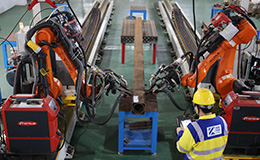 2026-9-12 Advantages of S690 Piling H-Beams
 -
2026-9-03 How to Achieve Faster Construction with High-Strength Steel Structures
-
2026-9-17 Who Are the Suppliers of S690 High-Performance Structural Steel Sections?
-
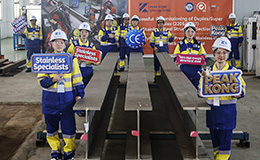 2026-6-16 Stainless Steel Structural Profiles 316L/1.4404
 -
2026-9-10 How to Improve the Yield-to-Tensile Ratio and Elongation of S960 Ultra-High-Strength Steel Structural Sections?
-
2026-9-17 How to Lower the Yield-to-Tensile Ratio and Improve Elongation of S690 High-Strength Steel Structural Sections?
-
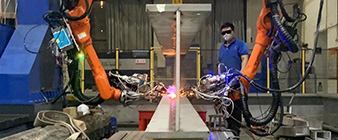 2024-1-02 Celebrating the application of laser welded stainless steel structural profiles in Yuen Long Sewage Treatment Plant