

For world-class steel structure projects, especially those complying with EN 1090-2 EXC3/EXC4 requirements, Peakkong Special Steel regards the ITP (Inspection and Test Plan) as the core control document that must be submitted to the client and consulting company for approval prior to construction, in addition to welding and temperature control records.
The ITP clearly defines the supervision level for each process: Hold Point (H Point – mandatory stop for inspection), Witness Point (W Point – on-site visual supervision), Review Point (R Point – document review), together with Technical Submission / Method Statement.
Accordingly, we have fully integrated the ITP inspection plan into Peakkong Special Steel’s process specifications, providing you with a complete technical and QA/QC package for project commencement.
ITP for Fabrication and Inspection of S690QL (10–80mm) Steel Structures, Peakkong Special Steel Execution Class: EN 1090-2 EXC3 / EXC4 Applicable Standards: EN 1011 & AWS 9.4
H (Hold Point): Work must be suspended. The next process may only proceed after joint on-site inspection and signature by the QA/QC team and the client/supervisor’s representative. W (Witness Point): QC personnel or supervisors conduct on-site inspection of welding and testing operations. If they fail to attend as scheduled, the factory may continue work after completing and filing detailed records.
R (Review Point): 100% verification and review of all written documents including material certificates, test reports and qualification certificates.
This specification integrated with the pre-commencement ITP achieves textbook-level compliance when processing high-difficulty, high-risk S690QL heavy plates with thickness ranging from 10mm to 80mm:
1. Locked Hold Points in ITP: We designate H Points for four high-risk processes that are most prone to quality incidents: 3mm mechanical edge machining, pre-welding preheating, post-welding hydrogen removal, and delayed NDT inspection. No subsequent process is permitted unless approved by the factory QC team with qualified heat treatment data, which completely eliminates non-compliant operations by workers at the source.
Pre-commencement ITP as a technical firewall: Submitting this ITP to the client’s engineers and consulting company prior to construction directly demonstrates Peakkong Special Steel’s Factory Production Control (FPC) capability required for EXC3/EXC4 classification.
100% closed-loop process: A robust quality traceability chain is formed, starting from the heat number and test reports of raw materials, through heat input calculation on welding logs and hydrogen removal curves on temperature control records, and finally linked directly to UT/MT NDT report numbers.
This ultimate process specification integrated with ITP meets the technical standard of being exempt from repeated inspection and queries during reviews of large-scale government public steel structure projects across Europe, Singapore and Hong Kong (e.g., CEDD, ArchSD).
This specification governs all procedures of Peakkong Special Steel for processing, welding, heat treatment, QA/QC inspection, corrosion protection and on-site installation of S690QL high-strength steel structures with thickness 10–80mm. All procedures strictly follow the following top international standards:
• EN 1090-2: Execution of steel structures and aluminium structures – Technical requirements for steel structures (EXC3 / EXC4 classification)
• AWS Welding Handbook 9.4: Guidelines for Advanced Structural Steel Welding
• EN 1011-1 & -2: Welding — Recommendations for welding of metallic materials (temperature control standard for welding)
Welder Qualification All welders engaged in welding operations must pass ISO 9606-1 examinations and hold valid welder certificates. The scope covered by each certificate shall match the actual welding positions and joint types.
Welding Procedure Qualification Prior to welding, Welding Procedure Qualification Record (WPQR) shall be carried out strictly in accordance with EN ISO 15614-1, and a formal Welding Procedure Specification (WPS) shall be compiled based on the qualified WPQR report.
Raw Material Incoming Inspection and Mechanical Testing
• Certificate verification: 100% check the Material Test Certificate (MTC) of S690QL materials and match it with the heat number marked on each steel plate.
• Re-testing: Conduct tensile, bending and low-temperature impact tests (-40°C or -60°C) batch by batch to ensure impact energy values fully comply with Q+L steel standards.
Edge Preparation (Dual Crack Prevention Process)
1. Laser cutting: High-precision laser cutting is adopted for component cutting and preliminary groove forming.
2. 3mm mechanical edge machining: After laser cutting, 3mm of edge material must be removed using a mechanical edge milling machine.
Technical principle: This step completely removes the hardened layer (micro martensitic microstructure) generated by high temperature during laser cutting, restores the pure crystalline structure of the base metal on the groove surface, and fundamentally prevents micro cracks at the welding root.
Fit-up Assembly Strictly control fit-up gap, groove angle and misalignment. Forced assembly is prohibited to reduce additional constraint stress of the structure and prevent lamellar tearing.
Preheating and Temperature-Controlled Welding (in accordance with EN 1011)
Pre-welding preheating (100°C – 150°C): Uniform electric heating is applied using flexible heating bags or crawler-type ceramic heating mats according to plate thickness (10–80mm). Local uneven heating by gas flames is strictly forbidden. The preheating zone extends at least four times the plate thickness on both sides of the weld (minimum 75mm), monitored in real time by infrared thermometers.
Multi-layer and multi-pass temper welding: Interpass temperature is maintained between 125°C and 180°C during welding. Low heat input (1.0 – 2.5 kJ/mm) and multi-layer multi-pass welding technology are adopted. Heat from subsequent weld passes provides self-tempering to previous passes and refines grains in the Heat Affected Zone (HAZ).
Immediate Post-Welding Hydrogen Removal (Post-Heat Treatment / DHTO)
Timely hydrogen removal (200°C – 250°C): Immediately after welding, before the weld cools to ambient temperature, heat the weld and its both sides to 200°C – 250°C using ceramic heating mats. Slow cooling wrapped with thermal insulation cotton: Once the target temperature is reached, fully wrap the welding area with thick thermal insulation cotton to allow natural slow cooling.
Technical principle: Accelerates the escape of diffusible hydrogen in the weld, greatly releases residual tensile stress generated during welding of 10–80mm thick plates, and eliminates the driving force of hydrogen-induced delayed cracking (cold cracking).
Delayed NDT Inspection Time locking: After slow cooling to ambient temperature, components must be left standing for 24 to 48 hours (48 hours mandatory for plates thicker than 40mm) before NDT inspection. Inspection ratio (as required by EXC3/EXC4): 100% Ultrasonic Testing (UT) + 100% Magnetic Particle Testing (MT).
Surface Treatment and Anti-Corrosion Coating
• Shot blasting to Sa2.5 grade: All components are shot blasted to achieve Sa2.5 surface roughness.
• Abolition/reduction of pickling process (mandatory procedure): To prevent hydrogen embrittlement caused by hydrogen absorption of ultra-high strength S690QL steel in pickling solution, shot blasting is used to completely replace traditional pickling.
• Galvanizing and painting: High-quality hot-dip galvanizing and coating are carried out. Faying surfaces of high-strength bolts must be strictly masked during coating to retain pure blasted surfaces.
Packaging, Delivery and Site Installation
• Packaging and delivery: Protected packaging is used to prevent scratches and deformation of steel surfaces during transportation.
• On-site installation: High-strength bolt connection: Grade 10.9 high-strength bolts are adopted in strict compliance with Chapter 8 of EN 1090-2. Pre-tightening and final tightening are performed using calibrated torque wrenches to ensure slip resistance coefficient μ ≥ 0.5.
• On-site welding: Wind and rain shelters must be erected on site (welding prohibited when relative humidity exceeds 85%). Portable heating blankets are also required for on-site welding, following the identical process as in the factory: 100–150°C preheating plus 200–250°C post-welding hydrogen removal and insulated slow cooling.
After the two record forms above are completed, the QA/QC department implements the following mandatory control gates:
NDT Timing Lock Countdown
1. QA/QC engineers start timing from the moment when thermal insulation cotton slow cooling ends, as recorded on the Temperature Control Log.
2. 24 hours locked for plate thickness ≤40mm; 48 hours locked for plate thickness >40mm. The NDT team is not allowed to carry out inspection before the required time elapses.
NDT Report Number Registration After inspection, the report numbers of 100% UT and 100% MT are handwritten or attached directly to the remarks column of the Welding Log to form a complete closed loop.
Handover after Sa2.5 Shot Blasting
Only after the NDT report confirms no defects (no cracks or slag inclusions) can QC personnel issue a release order for components to enter the shot blasting process.
Components without qualified NDT results are strictly prohibited from shot blasting or galvanizing processes.
This set of QA/QC records and control logic fully complies with AWS and EN 1090-2 EXC4 requirements for quality control traceability of high-risk heavy structures. With this complete document package, Peakkong Special Steel demonstrates top-level professional compliance in factory audits of any international projects (e.g., projects of Hong Kong Highways Department and Civil Engineering and Development Department).
-
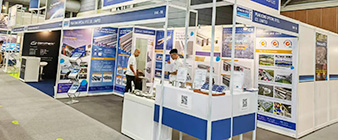 2024-12-06 Peak Kong Special Steel participated in the 2024 Singapore Asia Stainless Steel Exhibition.
 -
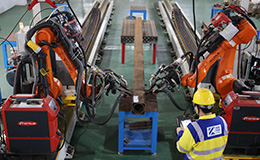 2026-9-17 Who Are the Suppliers of S690 Steel Structural Sections?
 -
2026-9-05 S690 High-Strength Steel Welding
-
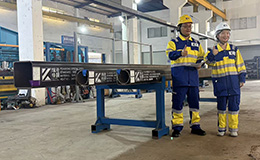 2026-9-15 S450 vs S690 Piling H-Beams — What Are the Advantages?
 -
2026-9-17 How to Lower the Yield-to-Tensile Ratio and Improve Elongation of S690 High-Strength Steel Structural Sections?
-
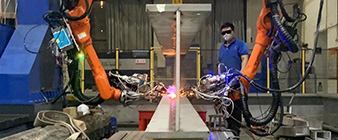 2024-1-02 Celebrating the application of laser welded stainless steel structural profiles in Yuen Long Sewage Treatment Plant
 -
2026-9-17 On-Site Welding Precautions for S690 High-Strength Steel