

In modern steel structure engineering and heavy infrastructure, the application of S690-grade high-performance structural sections (e.g. S690Q / S690QL) has become a core trend for achieving structural lightweighting, high seismic performance, and low carbon emissions.
Per the engineering and metallurgical logic of the European welding standard EN 1011, the precision low-temperature tempering (typically 150 °C – 250 °C) applied to S690 structural sections before delivery is the key to controlling the yield-to-tensile ratio (Y/T) and protecting the mechanical properties of the heat-affected zone (HAZ).
Suppressing HAZ Embrittlement to Ensure Joint Strength Compliance:EN 1011 warns: for QT or TMCP steel, excellent mechanical properties depend highly on the steel mill’s precision low-temperature / controlled-cooling heat treatment. If the steel is delivered with conventional high-temperature tempering, the HAZ during welding heat cycling easily undergoes secondary grain coarsening and martensite decomposition, creating a serious “softening zone” that drastically reduces overall joint strength. Precision-controlled low-temperature tempering at the mill maximises the thermal stability of the matrix microstructure, keeping the HAZ hardness curve within the safe line required by the standard during robotic narrow-bead welding, preventing brittle fracture from localised over-hardening.
Optimising Strain-Hardening Index (n-value) to Substantially Lower Y/T Ratio:Conventional drawback: As tempering temperature rises, tensile strength (Rm) drops faster than yield strength (Rp0.2), causing Y/T ratio to rise instead (closer to 0.95 or 1.0), making the material prone to brittle fracture immediately upon yielding — extremely dangerous in seismic design. Low-temperature tempering perfectly retains high-density dislocations and metastable microstructures (e.g. retained austenite via Q&P process, triggering the TRIP effect). When the section is loaded past the yield point, intense dynamic dislocation tangling raises tensile strength significantly, successfully lowering Y/T to around 0.85–0.88, providing the plastic deformation energy-dissipation space critical for highway bridges or high-rise buildings.
Eliminating Hydrogen-Induced Delayed Cracking per EN 1011-2: EN 1011-2 states that HIC is the greatest enemy. The standard requires comprehensive assessment of CEV, thickness, heat input, and diffusible hydrogen content (Hd). Low-temperature dehydrogenation: S690 is highly hydrogen-sensitive. The mill’s low-temperature tempering pre-releases over 80% of quenching residual stress. Immediately after welding, 200 °C–250 °C low-temperature post-heat (dehydrogenation) with 2–4 hours’ holding must be performed to force residual diffusible hydrogen to escape rapidly (ensuring Hd ≤ 5 ml/100 g), which is essential for passing EN 1011 WPQR.
Strictly Limiting Medium-High-Temperature Secondary Tempering (Conventional PWHT Prohibited): When S690 sections enter the workshop or site for processing, conventional medium-high-temperature (e.g. 550 °C–650 °C) post-weld stress-relief annealing (secondary tempering) in a furnace is absolutely prohibited. High temperature destroys the fine-grained microstructure stabilised by low-temperature tempering, drastically reducing section strength and rendering the structure scrapped.
Conventional high-strength steel is mostly delivered as plates, making secondary forming difficult. Peak Kong Special Steel’s advanced automated laser welding (Laser Fused) technology successfully produces a full range of long sections and hollow structural sections with excellent low Y/T and outstanding HAZ performance, directly solving the engineering pain point of high-strength steel’s inability to form complex geometric cross-sections:
1. Laser-welded open sections: Laser Fused H-Beams, I-Beams, Channels, Angles, and Unequal Angles.
2. High-end hollow structural sections: Large-diameter thick-walled tubes (CHS), Square Hollow Sections (SHS), Rectangular Hollow Sections (RHS).
If you need deeper technical standards, product specifications, and design optimisation support for S690/S960 high-strength steel structural sections, or EN 1011 / EN ISO 15614 welding procedure qualification (WPQR/WPS), we look forward to deep technical collaboration to advance the safe and efficient application of high-performance structural steel in infrastructure!
-
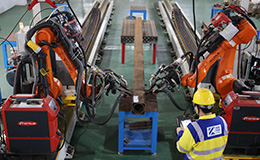 2026-9-17 How to Lower the Yield-to-Tensile Ratio and Improve Elongation of S690 High-Strength Steel Structural Sections?
 -
2026-9-05 Rework Procedure for S960 Ultra-High-Strength Steel Structural Welds
-
2026-9-17 Who Are the Suppliers of S690 Structural Steel Sections?
-
2026-9-08 Why Does S960 Steel Structural Section Choose Low-Temperature Tempering?
-
2026-9-17 Advantages of Robotic Welding for S690 High-Strength Steel
-
2026-9-12 Advantages of S690 Piling H-Beams
-
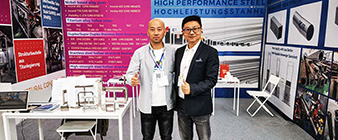 2026-5-28 Peak Kong Special Steel participated in the International Tubular Products Exhibition in Düsseldorf, Germany.