

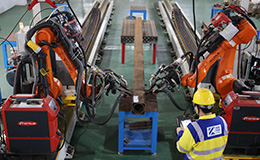
In the automated manufacturing of modern steel structures (e.g. long-span roof trusses, super-tall mega-columns, large highway bridges, piling and marine projects), robotic automatic welding technology (e.g. GMAW/FCAW combined with CMT Cold Metal Transfer process) for processing and manufacturing S690-grade high-performance high-strength steel structural sections offers overwhelming technical and economic advantages.
Since S690’s process window is extremely narrow, conventional manual welding easily exceeds heat input limits due to hand tremor, fatigue, and uneven welding speed, destroying the quenched-and-tempered microstructure and causing severe HAZ softening or embrittlement.
The following details the five core advantages of S690 robotic welding under the EN 1011 framework:
Achieving “ultimate low heat input” and precision closed-loop heat control, perfectly protecting HAZ microstructure:Manual welding pain point: S690 welding requires heat input strictly limited to 1.0–2.5 kJ/mm. Manual arc welding easily exceeds limits, causing HAZ grain coarsening and martensite decomposition, forming a serious “softening zone” with 20%–30% joint strength loss. Robotic advantage: Robots maintain constant speed and angle, and can be paired with advanced waveform control technology (CMT Cold Metal Transfer or precision dual-pulse mode). This digital control reduces heat input to the S690 matrix to the physical limit, minimising HAZ thermal stimulation, ensuring the HAZ hardness curve remains within the safe line required by the standard (max hardness ≤ 450 HV, with no softening degradation).
Precise “interpass temperature” control, locking in the material’s original low Y/T and high elongation:Metallurgical characteristics: High-end S690 sections undergo precision low-temperature tempering at the mill, stably controlling Y/T at around 0.85–0.88 with total elongation exceeding 17%. Intelligent linked control: The robotic workstation can integrate non-contact far-infrared interpass pyrometers. During multi-pass welding, if the system senses interpass temperature above the limit (e.g. > 180 °C), the robot automatically enters “pause cooling mode,” resuming welding only after temperature drops back to the safe range. This closed-loop management prevents excessive heat accumulation, perfectly locking in the material’s original low Y/T and high ductile energy-dissipation capacity.
Eliminating “spatter and stress concentration,” multiplying structural fatigue life:Robotic welding achieves stable spray transfer or current-free droplet transfer (e.g. CMT process), achieving near-zero spatter and forming extremely uniform, symmetric weld reinforcement. The weld toe-base metal junction presents a smooth radius transition, significantly eliminating geometric stress concentration. For highway bridges, orthotropic bridge decks, or heavy machinery frameworks subject to high-frequency vehicle dynamic impact and fatigue sensitivity, this can multiply their fatigue life.
Powerful “intelligent seam-tracking and bridging capability,” perfectly tolerating assembly misalignment:Structural sections (H-beams, square tubes, large-diameter thick-walled tubes) inevitably have non-uniform groove gaps during assembly. The robotic workstation can be equipped with front-mounted laser vision seam-tracking and real-time dynamic tracking systems, microsecond-level dynamic scanning of groove geometry before welding, automatically correcting torch position, angle, and welding speed. Even facing 1–3 mm gaps, the robot can easily bridge and fill without large lateral oscillation (strictly prohibited for S690 welding), ensuring root pass high-quality penetration.
Linked “automatic preheating and post-weld dehydrogenation,” reducing site delayed cracking risk to zero:The most deadly enemy of high-strength steel is hydrogen-induced delayed cracking. The robotic workstation can be system-linked with electromagnetic induction heating coils. Before start-up, the robot can automatically verify preheat temperature has reached 75 °C–120 °C; the instant the weld is filled (while hot), the system automatically triggers the dehydrogenation program, performing 200 °C–250 °C low-temperature dehydrogenation post-heat with 2–4 hours’ holding.
-
 2026-9-07 Applications of S960 Ultra-High-Strength Steel in Highway Bridges
 -
2026-9-17 How to Lower the Yield-to-Tensile Ratio and Improve Elongation of S690 High-Strength Steel Structural Sections?
-
2026-9-17 On-Site Welding Precautions for S690 High-Strength Steel
-
2026-9-17 Who Are the Suppliers of S690 Structural Steel Sections?
-
2026-9-03 Manufacturing Process of S690QL High-Strength Steel Structures
-
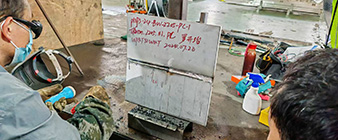 2025-1-06 The welding team at Peak Kong Special Steel has successfully completed the welding procedure qualification for duplex stainless steel and super duplex stainless steel 2205/2507.
 -
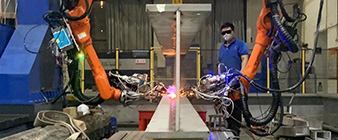 2024-1-02 Celebrating the application of laser welded stainless steel structural profiles in Yuen Long Sewage Treatment Plant