

What Are High-Strength Steel Structures?
A high-strength steel structure is a load-bearing building or mechanical frame system mainly fabricated from special structural steel with a yield strength of no less than 460 MPa. In modern top-tier structural engineering, S690 and S960 represent the international highest standard of ultra-high-strength quenched and tempered structural steels, manufactured in accordance with European standard EN 10025-6.
Ultimate strength: The minimum yield strengths of S690 and S960 reach 690 MPa and 960 MPa respectively (the conventional S355 steel widely used in ordinary steel structures is only 355 MPa), resulting in a 2 to 2.7 times increase in load-bearing capacity. Strength-toughness balance: These materials break the physical rule that “the harder a material is, the more brittle it becomes”. Qualified QL/QL1 grade steel maintains high Charpy V-notch impact energy even at extremely low temperatures of -40°C or -60°C. This ensures that structures undergo plastic deformation rather than sudden catastrophic brittle fracture under ultimate load or severe earthquakes, providing excellent safety redundancy.
Profiles of S690 and S960 High-Strength Steel
Due to the extremely high hardness and strength of S690 and S960, conventional hot-rolled large-size profiles are very difficult to process. In current international high-end steel structure projects (compliant with the highest execution class EN 1090-2 EXC3/EXC4), the following geometric profiles are mainly produced by high-precision laser fusion welding and automatic arc welding:
• H-Beams / I-Beams (HEA/HEB/IPE Beams): H or I cross-section with wide flanges and high bending section modulus. S690 H-beams are mostly used as mega composite columns of super high-rise skyscrapers, transfer truss girders and heavy-load main bearing girders.
• Channels (U/C-Shapes): Open C/U geometric section. It achieves ultra-light weight while retaining high strength, and is widely used for vertical frames of modern high-rise curtain walls and shear bases of heavy industrial equipment.
• Angles (L-Shapes), including equal and unequal leg angles: Mainly applied to transmission towers, tie rods, web members of large-span space trusses and gusset plates for complex joints.
• SHS (Square Hollow Sections): Square hollow tubes with perfect four-way symmetry, excellent torsional resistance and bidirectional bending rigidity. They are commonly used in exposed large-span main frames of large public buildings.
• RHS (Rectangular Hollow Sections): Rectangular hollow tubes specially designed for curtain wall lattice structures and beams & columns that require high rigidity in a single bending direction.
• CHS (Circular Hollow Sections): Circular hollow steel tubes with the lowest wind resistance coefficient and uniform stress distribution across the section. S690/S960 CHS are mostly high-grade seamless pipes or large-diameter laser welded pipes, serving as key load-bearing components of steel arch bridges and large-span pipe trusses for stadiums.
Main Types of High-Strength Steel Structure Applications
Ultra-high strength steel structures are mainly used for extreme engineering scenarios featuring heavy load, super large span, extreme weight reduction and high-frequency dynamic load fatigue resistance:
1. Super High-Rise & Heavy Frameworks Multi-story load-bearing systems composed of S690 box columns (filled with high-strength concrete) and H-beams. They are applied in skyscrapers over 300 meters high, nuclear island steel structures and extra-heavy industrial plants, which can halve the cross-sectional size of bottom columns.
2. Large-Span Space Truss Structures Three-dimensional space grid systems formed by precise intersecting welding of CHS, SHS and other pipes. Widely used in large high-speed railway stations, airport terminals and stadiums, realizing super large spans without any internal supporting columns.
3. Long-Span Bridge Structures Mega steel box girders, steel truss girders and anchorage nodes of cable-stayed bridge towers fabricated by welding S690 high-strength steel plates. Such structures have extremely high requirements for steel’s dynamic load fatigue resistance and lamellar tearing resistance (Z-direction properties).
4. High-Rise Towers & Special Structures Including high-power wind turbine towers, ultra-high television transmission towers and heavy reaction kettle support towers for chemical plants, designed to resist extreme wind loads and seismic actions.
5. Heavy Mobile Machinery Structures Multi-section telescopic booms of 1000-ton all-terrain cranes (the primary application of S960), crawler crane booms and lightweight carriage bodies of open-pit mine dump trucks.
To translate the material advantages of S690 and S960 into practical engineering benefits, we cannot follow the construction logic for ordinary steel; instead, a full-life-cycle efficient construction strategy must be adopted:
Refined Hybrid Structural Design Avoid full-structure application of high-strength steel: The core of efficient construction is to only replace core nodes, mega bottom columns and large-span main girders bearing heavy axial load, large shear force or extreme bending moment with S690/S960. Graded material matching: Secondary members (secondary beams, conventional bracings, floor purlins) still adopt conventional S355 steel. This hybrid design gives full play to the lightweight advantage of high-strength steel while controlling the total procurement cost of raw materials.
DfMA (Design for Manufacture and Assembly) and On-site High-Strength Bolted Connections
90% of welding processes completed in the factory: The dual crack-prevention groove machining, preheating, multi-layer multi-pass welding and 250°C post-weld hydrogen removal of S690/S960 have strict requirements on temperature and humidity. All key welding operations must be finished in the automated controlled environment of the factory. Zero welding on construction site: 100% of on-site splicing adopts friction-type connections with Grade 10.9 or higher strength bolts. Components are pre-assembled in the factory, with faying surfaces masked and coated in advance.
Only pre-tightening and final tightening with torque wrenches are required on site. This completely eliminates the interference of overhead on-site welding and outdoor weather on welding quality, and improves construction efficiency by more than three times.
Pre-commencement ITP and Automated NDT (Phased Array UT) Time locking by standardized procedures: In the Inspection and Test Plan (ITP), “24–48 hours delayed inspection after welding” is set as a mandatory Hold Point, preventing the next process from being carried out before complete hydrogen removal due to schedule pressure. Upgraded inspection technology: In the NDT stage, Phased Array Ultrasonic Testing (PAUT) or Time of Flight Diffraction (TOFD) replaces traditional manual UT. Automatic flaw detection generates digital images in real time and locates defects to millimeter accuracy, greatly shortening the non-destructive testing and review cycle of ultra-high strength thick steel plates to ensure high efficiency and quality.
Peakkong Special Steel possesses practical experience and professional compliance capabilities for world-class projects in high-precision factory processing of S690 and S960 ultra-high performance steel structures, preparation of Technical Submission / Method Statement, pWPS/WPQR welding qualification and pre-commencement ITP quality control. If you require detailed specifications, factory production capacity, project quotations, or customized material and construction technical proposals for your project, please feel free to contact us.
-
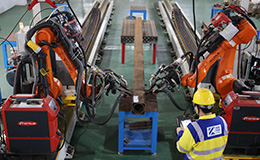 2026-9-17 Advantages of Robotic Welding for S690 High-Strength Steel
 -
2026-9-03 How to Achieve Faster Construction with High-Strength Steel Structures
-
2026-9-10 Suppliers of S960 Ultra-High-Strength Steel Structural Sections
-
2026-9-05 S690 High-Strength Steel Welding
-
2026-9-07 Applications of S960 Ultra-High-Strength Steel in Highway Bridges
-
2026-9-12 Advantages of S690 Piling H-Beams
-
2026-9-07 Applications of S960 Ultra-High-Strength Steel in Buildings