

High-strength steel structures (generally referring to steel with yield strength ≥ 460 MPa, such as S690 and S960 under top-grade European standard EN 10025-6) have core advantages over conventional steel structures (e.g., standard S355 steel) in three aspects: extreme weight reduction, cost-effective closed loop, and excellent strength-toughness balance.
Extreme structural weight reduction Its load-bearing capacity is 2 to 2.7 times higher than conventional steel. Under the same load requirements, the thickness and cross-section of steel plates can be reduced by 30% to 50%, leading to a sharp decrease in the self-weight of the overall structure and building foundations.
Significant reduction in overall welding costs Reduced plate thickness results in a geometric decrease in the cross-sectional area of welding grooves, which greatly cuts down the consumption of welding wire, energy use for welding, and labor hours for welding operations.
Lower indirect costs for transportation, hoisting and installation Lighter components reduce the number of logistics trips. Smaller-tonnage cranes can be used for on-site installation, and the speed of on-site assembly is greatly improved. The total cost is more competitive compared with conventional steel materials.
High safety redundancy from balanced strength and toughness Qualified QL/QL1 grade high-strength steel retains high impact toughness even at extremely low temperatures of -40°C or -60°C. When subjected to extreme wind loads, earthquakes or overloading, the structure undergoes plastic deformation instead of sudden catastrophic brittle fracture.
Due to the extremely high hardness of S690 and S960 steel, conventional large-size hot rolling is extremely difficult. For international high-end projects complying with EN 1090-2 EXC3/EXC4 standards, the following geometric profiles are mainly manufactured by high-precision laser fusion welding or special heavy-duty cold-bending high-frequency welding:
• H-Beams (HEA / HEB / IPE)
• I-Beams (UB / S / HEM)
• Channels (U & C-Shapes)
• Angles (equal and unequal leg L-Shapes)
• SHS (Square Hollow Sections)
• RHS (Rectangular Hollow Sections)
• CHS (Circular Hollow Sections)
The fabrication of S690 and S960 high-strength steel structures relies heavily on strict welding procedures and quality control, including: 3mm mechanical grooving after laser cutting to remove hardened layers, preheating at 100–150°C, immediate hydrogen removal at 200–250°C after welding followed by slow cooling with thermal insulation cotton, and rejection of pickling to prevent hydrogen embrittlement. Main component types:
• Steel Trusses
• Cross-Shaped Columns
• Pipe Truss Structures
• Built-up H-Beams (BH welded H-sections)
• Box Columns (BOX structures)
• Bridge Structures
• Wind Towers
To convert the material advantages of high-strength steel into efficient on-site construction, we need to break away from traditional construction methods and adopt a full-life-cycle efficient construction strategy:
Refined Hybrid Structural Design: Partial Application of High-Strength Steel Avoid using S690/S960 high-strength steel for the entire structure. Only core joints, mega bottom columns (cross columns, box columns) and large-span main girders (steel trusses) bearing heavy axial load, large shear force or extreme bending moment are made of S690/S960. Secondary members remain conventional S355 steel. This graded material matching effectively controls the total procurement cost of raw materials.
DfMA and On-Site High-Strength Bolted Connections
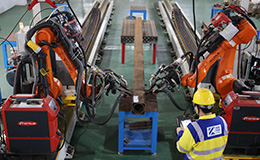
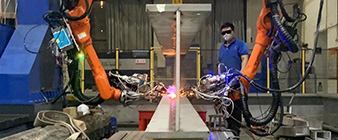
90% of welding processes are completed in the factory: Groove machining, preheating welding and 250°C post-weld hydrogen removal of S690/S960 steel have strict requirements for temperature and humidity. All key welding operations must be finished in the automated controlled environment of the factory.
Zero welding on site: 100% of on-site splicing adopts friction-type connections with Grade 10.9 or higher strength bolts. Components are pre-assembled in the factory, with faying surfaces masked and coated in advance. Only pre-tightening and final tightening with torque wrenches are required on site.
Pre-Construction ITP and Automated NDT
Time locking by standardized procedures: In the Inspection and Test Plan (ITP), “24–48 hours delayed inspection after welding” is set as a mandatory Hold Point, preventing subsequent processes before complete hydrogen removal due to construction schedule pressure.
Phased Array Ultrasonic Testing (PAUT): PAUT replaces traditional manual UT. Automated flaw detection generates digital images in real time and locates defects to millimeter accuracy, greatly shortening the non-destructive testing and review cycle of ultra-high-strength thick steel plates to ensure high efficiency and quality.
Peakkong Special Steel has rich practical experience and professional compliance capabilities for world-class projects in high-precision factory processing of S690/S960 ultra-high-performance steel structures, preparation of Technical Submission / Method Statement, pWPS/WPQR welding qualification assessment, and pre-construction ITP quality control.
If you require detailed specifications, factory production capacity, project quotations, or customized material and construction technical proposals for your project, please contact us.
-
 2026-9-07 Applications of S960 Ultra-High-Strength Steel in Highway Bridges
 -
 2024-12-06 Peak Kong Special Steel participated in the 2024 Singapore Asia Stainless Steel Exhibition.
 -
 2024-1-02 Celebrating the application of laser welded stainless steel structural profiles in Yuen Long Sewage Treatment Plant
 -
2026-9-17 On-Site Welding Precautions for S690 High-Strength Steel
-
 2026-6-16 S960QL Ultra-High Strength Structural Steel Profiles
 -
2026-9-09 Low-Temperature Tempering Process for S690 High-Performance Structural Sections
-
 2026-6-16 Stainless Steel Structural Profiles 316L/1.4404